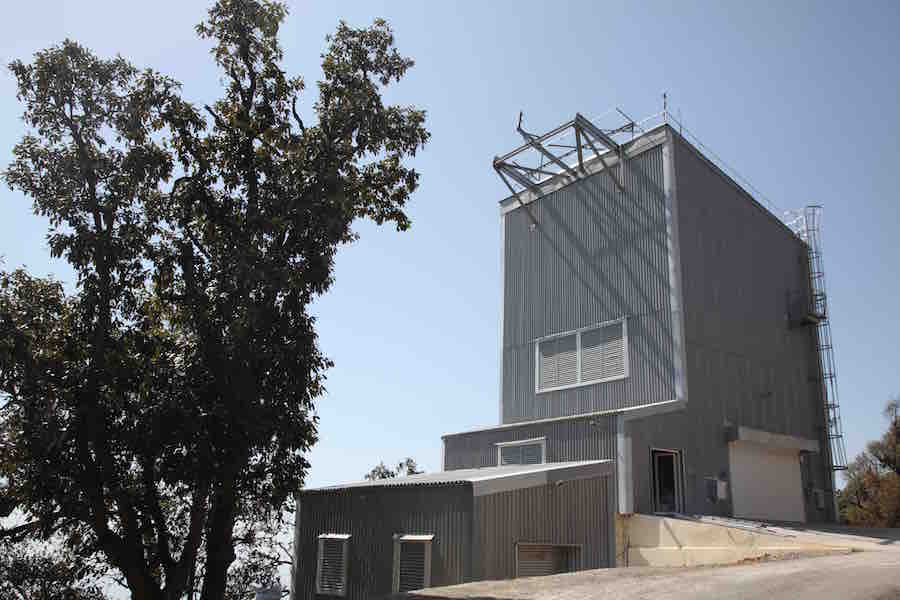
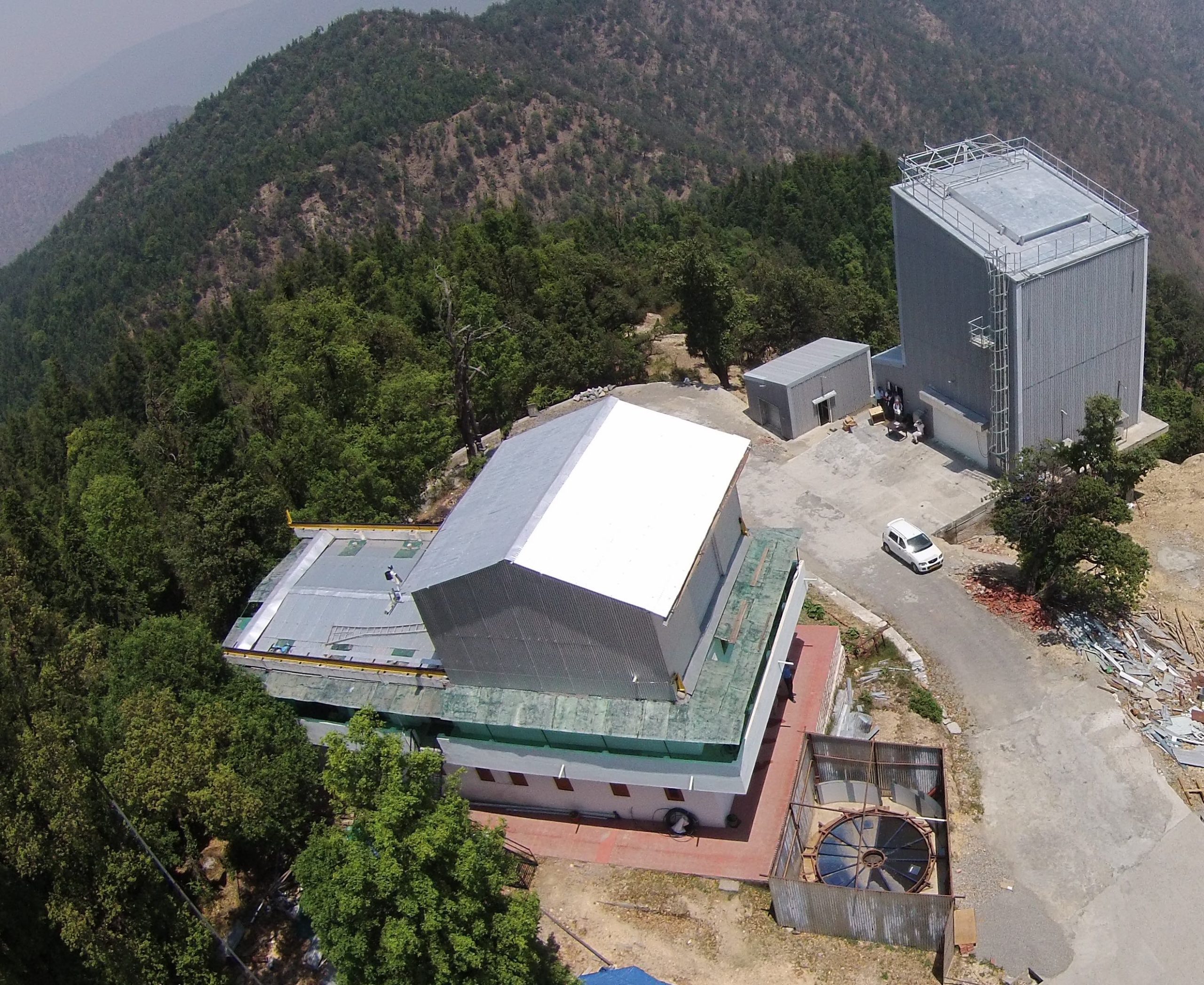
A Liquid Mirror Telescope (LMT) consists of a liquid mirror in rotation around the vertical axis, an optical corrector and a CCD camera installed at the focus of the mirror. The concept of a liquid mirror telescope can be traced back to the XVIIth century when Isaac Newton demonstrated that the surface of a spinning liquid takes the shape of a paraboloid, the perfect surface of reference to focus into a single point a beam of parallel light rays.
But it was not until the end of the XIXth century that anyone tried to build a liquid mirror (LM). In 1875, Henry Skey (New Zealand) built in the laboratory a ∼ 35cm LM. In 1909, Robert Wood constructed at the Johns Hopkins University (Baltimore, USA) a 51 cm prototype, and made first sky observations but annoying ripples were produced at the surface of the mercury because of vibration transmission and the difficulty to keep constant the angular rotation of the mirror.
In 1982, Ermanno Borra found a solution to some of the technical challenges encountered by Robert Wood. The former suggested dampening the vibrations that caused the ripples by using a pressurized air-bearing to sustain the dish. He also suggested pouring a liquid resin on the dish surface first, letting it dry into the right shape, then pouring reflective liquid onto it as a coating, diminishing at the same time the amount of mercury needed.
In 1994, Paul Hickson, Ermanno Borra and their collaborators, built an experimental 2.7-m diameter liquid mirror telescope at the University of British Columbia (UBC) near Vancouver. Paul Hickson also worked with NASA on a 3-m liquid mirror telescope in New Mexico to observe space debris. In the early 2003, Hickson built the 6-m Large Zenith Telescope (LZT) to extend LM technology to larger apertures. The 4-m International Liquid Mirror Telescope (ILMT) project was first proposed during the Science with LMTs workshop organized by Prof. Ermanno Borra on April 14-15, 1997 at the Marseille Observatory (France).
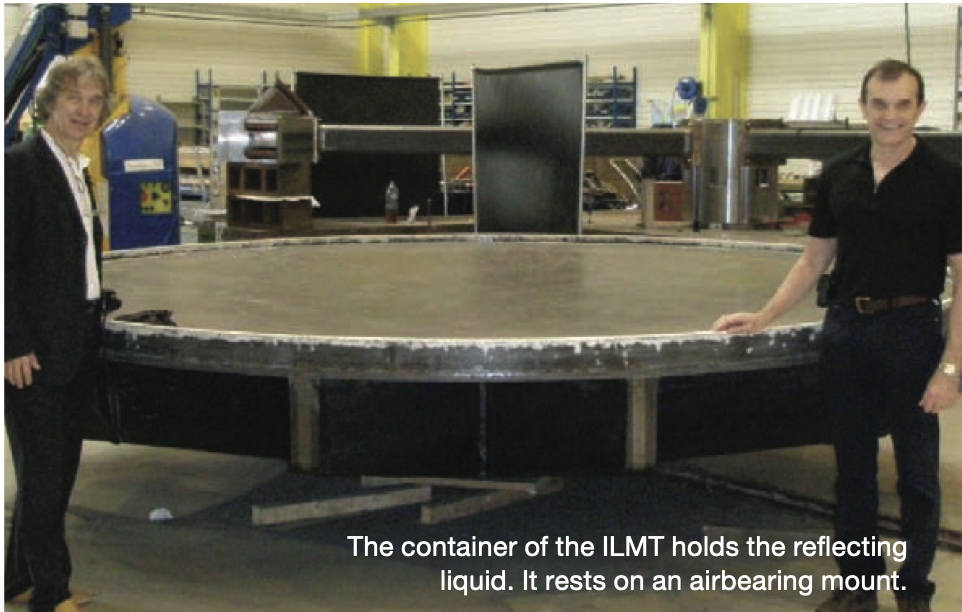
2005, construction of the ILMT container at AMOS, at the left Professor Jean Surdej, at the right Professor Ermanno Borra.
(© 2005 J.Surdej & A.Pospieszalska)

In 2010 when Professor Ram Sagar (at that time director of ARIES) visited AMOS (Liège, Belgium), an agreement was found between Belgium, Canada and India to install the ILMT in Devasthal (Uttarakhand, India).
In 2013, visit of Professor Paul Hickson (UBC University), Professor Jean Surdej (Liège University), and Professor Ram Sagar at the ARIES site of Devasthal.
(© 2013 J.Surdej & A.Pospieszalska)
After several years of design work in Belgium (ULiège) and construction in Belgium (AMOS) and India, commissioning began in April 2022. The telescope achieved first light on 29 April 2022.
The 4-meter ILMT is located on the ARIES site of Devasthal (Uttarakhand, India, Longitude = 79°41′07.08′′E, Latitude = 29°21′41.4′′N, Altitude = 2378m). The inauguration took place on the first Spring day of 2023, i.e. on 21st of March.
For more complete information consult the Journal articles
Liquid-Mirror Telescopes
- Liquid Mirror Telescopes, Paul Hickson, American Scientist, May-June 2007, Vol 95 Number 3, p.216
- The International Liquid Mirror Telescope, Borra, Ermanno; Hickson, Paul; Surdej, Jean, 2009 • In Optics and Photonics News, 20 (4), p. 28-33
- The 4-m International Liquid Mirror Telescope: a brief history and some preliminary scientific results, Surdej, Jean et al., 2024 • In Bulletin de la Société Royale des Sciences de Liège, 93 (2), p. 1054–1068
- The 4 m International Liquid Mirror Telescope: Construction, operation, and science, Surdej, Jean; Hickson, Paul; Misra, Kuntal et al., 2025 • In Astronomy and Astrophysics, 694, A80