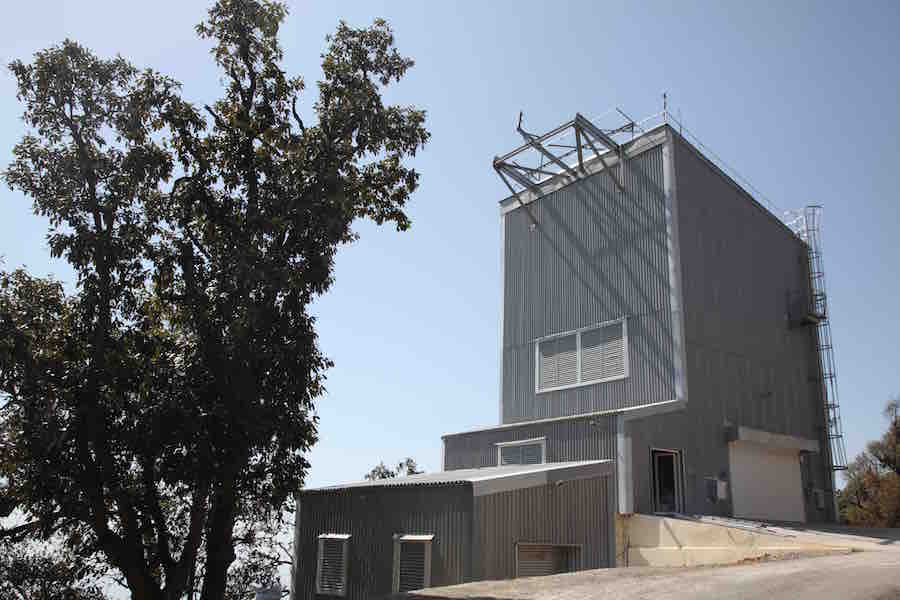
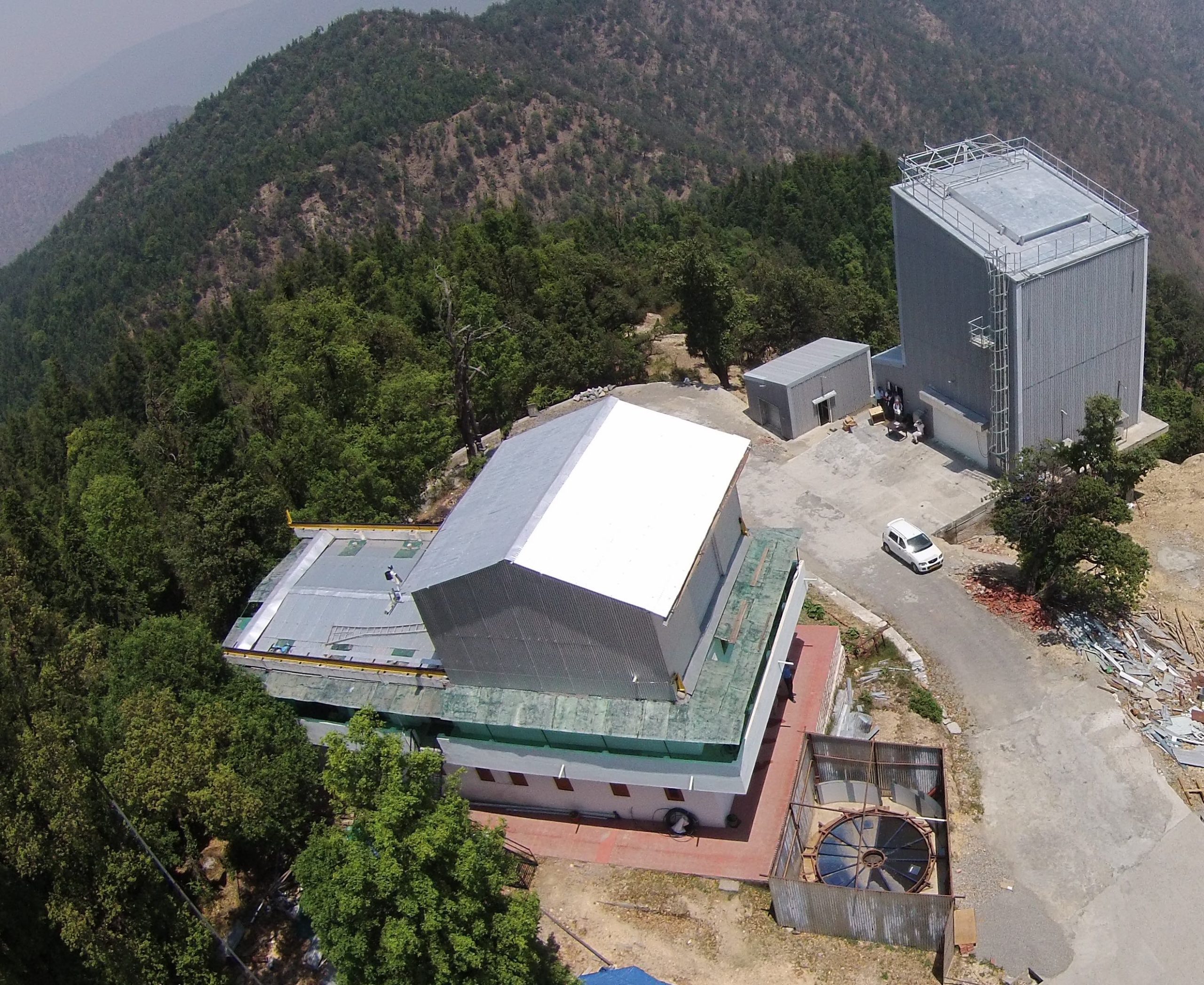
Aryabhatta Research Institute of Observational sciences (ARIES) Manora Peak, Nainital
India now has a world-class 4-m optical telescope at Devasthal in Uttarakhand which achieved its first light on 29 April 2022.
The telescope is ready to explore the deep celestial sky. It is indeed with great pride that ARIES announced the inauguration of the 4-m International Liquid Mirror Telescope (ILMT) on 21 March 2023 by the Honourable Minister of State for Science & Technology and Earth Sciences, Government of India, Dr. Jitendra Singh, in the gracious presence of the Honourable Governor of Uttarakhand, Lt. Gen (Retd.) Gurmeet Singh, and Belgian and Indian dignitaries at Devasthal.

From left on the photo: Anne-Sophie Nyssen, Ronald Van der Linden, S. K. Varshney, Didier Vanderhasselt, Jean Surdej, Brigitte Decadt
The 4-m International Liquid Mirror Telescope has just been inaugurated in India in the presence of Didier Vanderhasselt (Belgian Ambassador to India), Prof. Anne-Sophie Nyssen (Vice-Chancellor of the University of Liège), Prof. Dipankar Banerjee (Director of ARIES), Dr. Kuntal Misra (in charge of the telescope at ARIES) and Prof. Jean Surdej (Principal Investigator of the 4-m ILMT project, University of Liège). Were also present: Brigitte Decadt and Laurent Ghys (BELSPO), Synhaeve Timothy (Embassy of Belgium), Guillaume de Bassompierre (AWEX), Xavier Verians (AMOS), Dr Ronald Van der Linden (Director of ROB) and Dr Peter De Cat (ROB and Belgian organizer of BINA). There were about 250 participants among which some 35 Belgian ones.
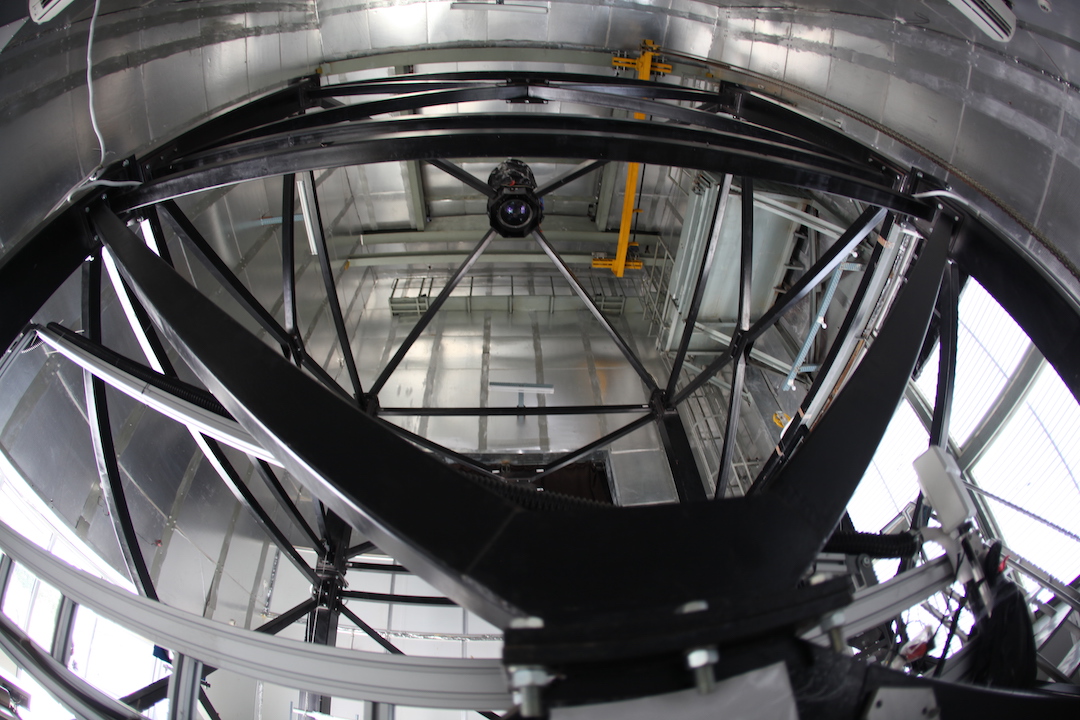
Bottom to top view of the 4-m International Liquid Mirror Telescope. The dedicated optical corrector is well seen at the top of this picture.
The ILMT employs a 4-metre diameter rotating mirror made up of a thin layer of liquid mercury, to collect and focus light. The metal mercury is in liquid form at room temperature and at the same time highly reflective. Hence, it is ideally suited to form such a mirror. The ILMT is designed to survey the strip of sky passing overhead each night, allowing it to detect transients and variable celestial objects such as supernovae, active galactic nuclei, multiply imaged quasars, space debris, asteroids, etc.
There are several main components in a liquid mirror telescope: i) A bowl containing a reflecting liquid metal (essentially mercury), ii) a motorized air bearing on which the liquid mirror sits, iii) a drive system, iv) a fixed telescope structure holding an optical corrector and a CCD camera. Liquid mirror telescopes take advantage of the fact that the surface of a rotating liquid naturally takes on a paraboloid shape, which is ideal for focusing light. A scientific grade thin transparent film of mylar protects the mercury from air friction that could induce ripples over the mercury surface. The reflected light passes through a sophisticated multi-lens optical corrector that produces sharp images over a wide field-of-view. A 4k ⨯ 4k CCD camera, located above the mirror at the focus, records a 22.3 arcminute wide strip of the sky.
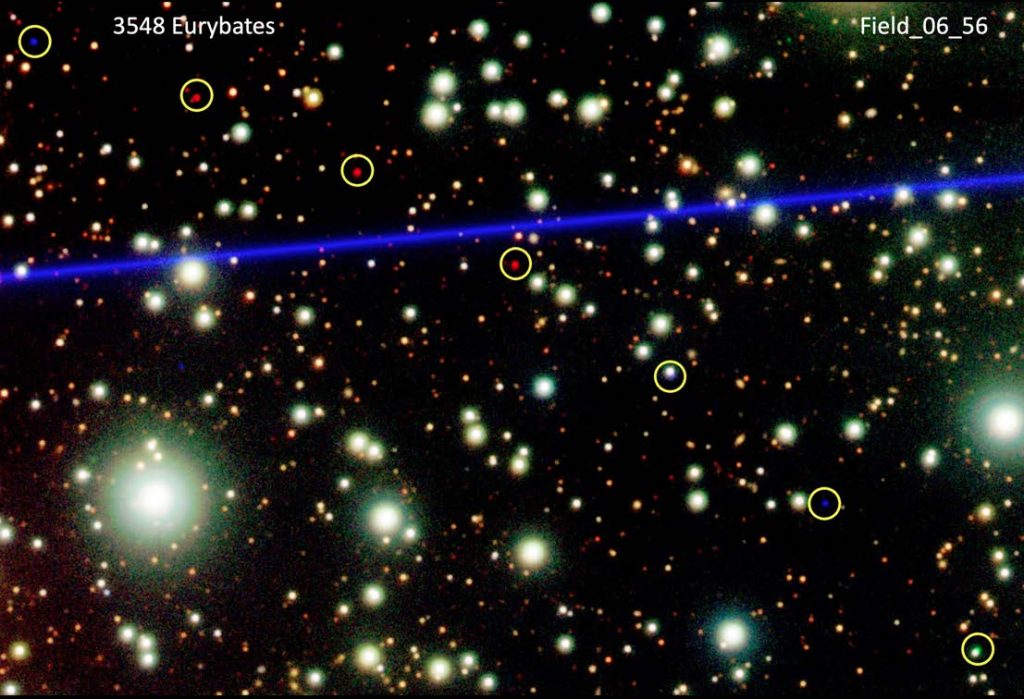
Colour composite photograph of a small portion of the sky observed with the ILMT through the g, r and i Sloan filters. Seven positions of the asteroid 3548 Eurybates are seen on this picture. The blue streak is due to a passing space debris.
The data collected from the ILMT, over an operational time of 5 years, will be ideally suited to perform a deep photometric and astrometric variability survey. Multi spectral band observations have been obtained with the ILMT during the first commissioning phase of the telescope in October-November 2022. It is providing a treasure of data. Precise astrometric and photometric calibration of the data has been accomplished and hundreds of known asteroids, nebulae, planetary nebulae, distant galaxies, stellar clusters have already been identified (see the figures presented hereafter). The photometric follow-up of supernovae that have been detected is going on. There is no doubt that the ILMT constitutes a unique survey instrument that leads to new discoveries.
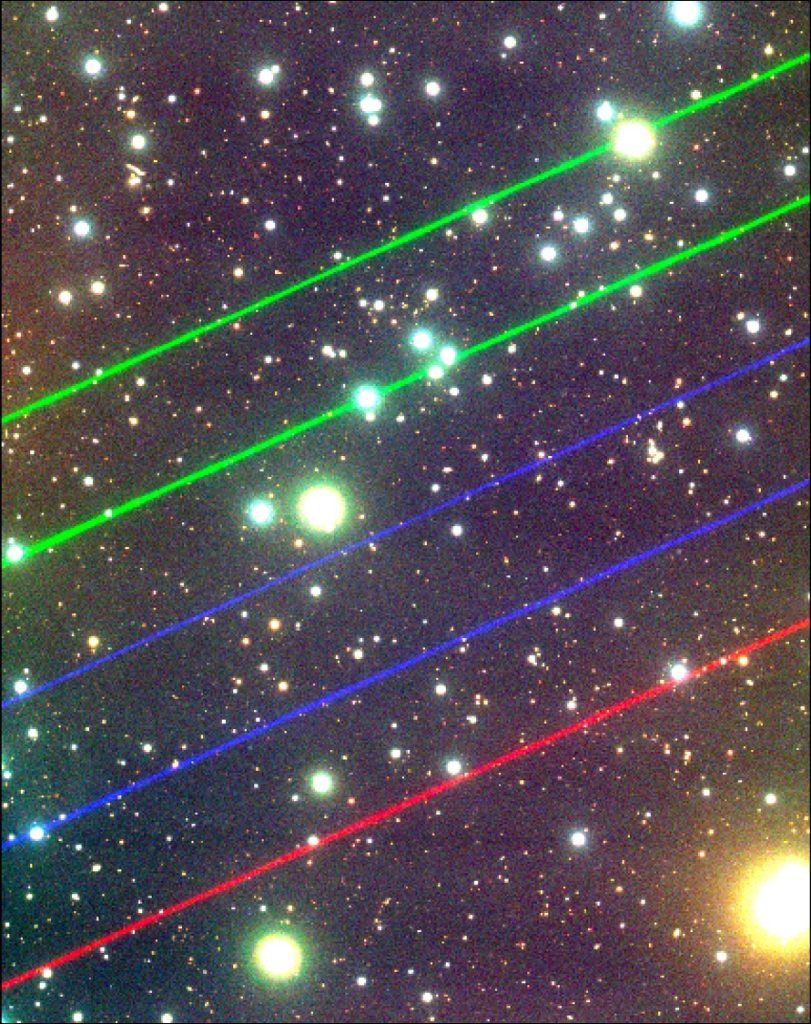
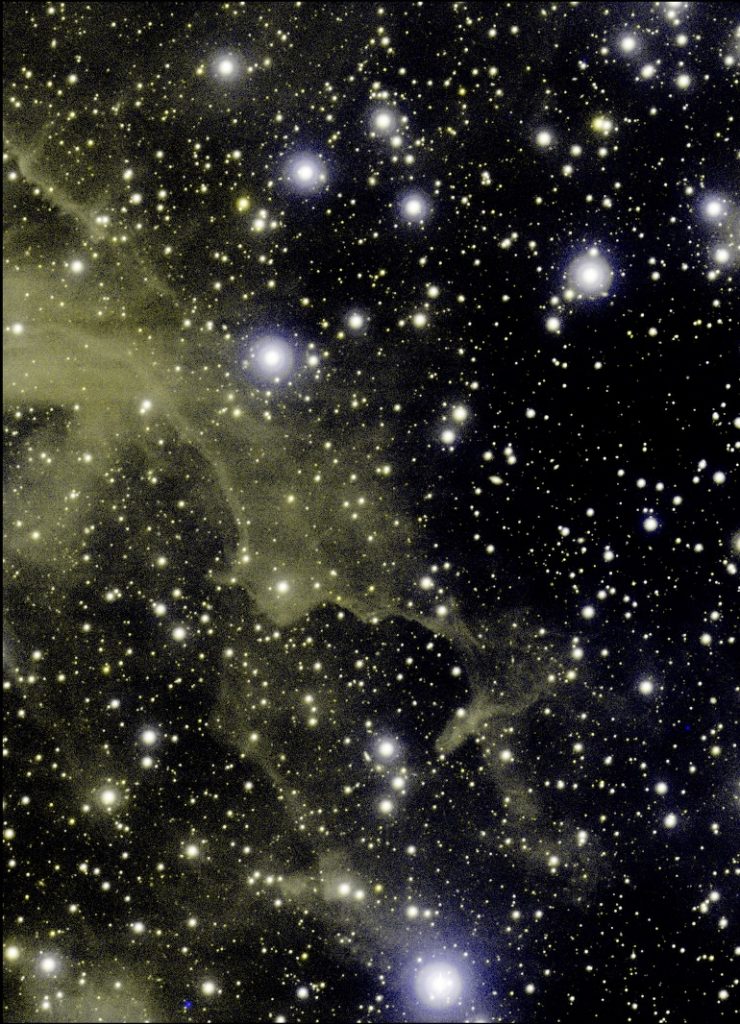
| Colour composite photograph of a small portion of the sky observed with the ILMT through the g, r and i Sloan filters. Streaks caused by Meridian 3 (37212), an old Russian satellite (ILMT, October 2022). | Colour composite photograph of a small portion of the sky observed with the ILMT through the g, r and i Sloan filters. A nice nebula is seen on this picture. It represents the ashes of a dead star. |
The ILMT collaboration includes researchers from University of Liège (Belgium), ARIES in India, University of British Columbia, Laval University, University of Montreal, University of Toronto, York University and University of Victoria in Canada, the Ulugh Beg Astronomical Institute of the Uzbek Academy of Sciences and National University of Uzbekistan in Uzbekistan.