The LMT didactical experiment:
Constructing your own “Home-made” liquid mirror telescope
What is a liquid mirror? As we all know, a perfect reflecting paraboloid represents the ideal surface for a mirror to focus parallel rays of light into a single point. It is therefore of the greatest importance to have realized that when a cylindrical container of liquid rotates at a constant angular velocity around its vertical axis, the surface takes the shape of a paraboloid under the constant pull of gravity and the centrifugal acceleration, which grows stronger as the distance from the central axis increases (E. Cappoci, 1850). The paraboloid shape occurs because a liquid surface always sets it local surface perpendicular to the net acceleration it experiences, which in this case becomes stronger and more inclined with distance from the central axis.
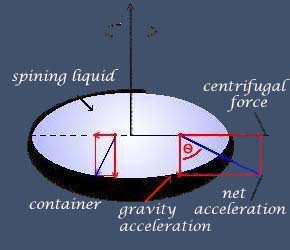

Acting forces on a liquid set in
a rotating container.
Paraboloid shape of the spinning
liquid with the distribution of forces acting on a single liquid particle.
A gramophone with a turntable of 20 cm in diameter may thus provide us with a perfect liquid mirror characterized by a focal ratio f/D ∼ 2, a very acceptable value for an astronomical mirror. For large mirrors of practical interest, the periods of rotation are typically of the order of several tens of seconds and the linear velocities at the rim of the mirrors range between 2 and 10 km/h, very near the velocity of a walking man.
It is very instructive to construct a small size liquid mirror by pouring in a small cylindrical container, set on the turntable of a gramophone, some polyurethane. After polymerization of the resin which has taken the shape of an approximate paraboloid, one may conveniently fill the latter with some used car oil (or mercury in the case of a real astronomical mirror). By means of a small eyepiece set at the focus of the spinning paraboloid, it then becomes possible to observe distant objects located just above the gramophone.
”Home-made” liquid mirror telescope: a cylindrical container, set on the turntable of a gramophone
filled with oil. In the attached video, you can see the liquid mirror taking the shape of a paraboloid. After installing a light bulb above the mirror, at a typical height of 3 – 4 meters or more, you can use a webcam or baking paper to find the image of the light source at a distance of approximately 60 cm above the mirror.
In our case, a few meters above the mirror is an illuminated slide depicting a galaxy. An image of this galaxy is then projected onto the focal plane, where a webcam has been installed. The resulting image of the galaxy is then displayed on the screen of a computer connected to the webcam.
This experiment is part of public outreach activities organized by ARIES (Nainital, Uttarakhand, India)